Showing posts with label BookReview. Show all posts

Thursday, January 12, 2012

New Moodle Book available

The new book published on Packtpub.com is a good guide for newbies to Moodle 2.x.  "Overview of Moodle 2.0 Course Conversion Beginner's Guide" by Ian Wild takes the reader through setting up a course to enhancing it with multi-media.  I like how it exemplifies converting an existing course into one with blended learning. Mr Wild uses a Physics course of his own to demonstrate how this "conversion" would be done.

His examples are clear and he does a great job of sorting out and emphasizing the most important steps.  You can easily see that this is written for teachers by a teacher.  Anyone can use this book to make that first move to online learning without any prior knowledge of the Moodle platform.
Being a Packt publication, the book is also available as an eBook which makes it affordable and portable. You can find the book at http://www.packtpub.com/moodle-2-0-course-conversion/book

Please note that I was fortunate enough to be one of the reviewers on this book.

Wednesday, June 03, 2009

joining the CASTLE summer book club

I just ordered the book and joined the Second annual CASTLE summer book club!  The book for this summer is "Why Don't Students Like School?" by Daniel Willingham.  This is a book that I have been meaning to read and what better way to really delve into the work than with over 80 other participants!


If this works as well and is as valuable as I anticipate, I may try using the format for teachers in my district next year.  So many great books, so few meeting times.


Wonder what vehicle Scott will choose for the discussions?

Technorati Tags: , , ,

Monday, May 04, 2009

Innovations in Education

I am hoping to finish my article for submission to this book.  You, too, can contribute.

The first edition, Education for a Digital World: Advice, Guidelines, and Effective Practice from Around the Globe, was published by the Commonwealth of Learning in July 08 and is available to download from their website.

The creation of this book employed a unique interactive collaborative research model, a forming relationships model, the sharing of ideas to produce new thinking model. It had almost 50 contributors from around the globe representing education, research, administration and business, it has a global perspective. Take a look at our map of contributors!

We are now working on a 2nd Edition. The tentative title is Innovations in Education, but it could become Education for a Digital World, Edition 2. It will be published by CoL to coincide with PCF6 in India 2010 from 24 - 28 November. http://www.col.org/progServ/panComm/Pages/pcf.aspx

An organizational meeting will be held online, May 22nd in elluminate. For details and further information visit our page in Wikieducator or our Book Wiki.

Technorati Tags: ,

Monday, April 27, 2009

Final thought on "The Game of School"

I have finished this book and am trying to absorb all it said to me. Here are a few thoughts from the final two chapters.

Chapter 6 -
Getting Stuck is a chapter about moving out of the game and into authentic learning. The most powerful part of the chapter was the "quiz", Fried's Joy and Misery Index for Educators (page 167).
Although I am no longer directly in classroom instruction, I registered my scores. I am happy to say that I am not a lost cause. I do see a way into authentic learning in our schools.

Chapter 7 -
No Time to Waste certainly says it all in the title. I was very impressed with the idea of teachers being required to address themselves directly to their students. The examples from pre-teacher students were motivating to me as I found myself wishing I could participate in their units. "Authentic learning is within our reach." (page 184)

If we can connect learning to learner, we can succeed. Just realizing that it is many times just a game, is a great start.


Technorati Tags:
, ,

Sunday, April 26, 2009

Game of School - part 2

The Game of School by Robert Fried
Some thoughts and quotes from Chapters 2 - 5

Chapter 2 -
As the child proceeds through school, he may learn many useful and interesting things. But he also learns to undervalue his own learning in favor of "doing the work," pleasing his teachers, getting good marks.. (page 24)

Chapter 3 - on spelling lists
For in forcing our "official" vocabulary lists on children and then testing them to see if they have memorized our words, we take their natural linguistic appetite and transform it thourgh acts of subservience and drudgery. (page 66)

Chapter 4 -
In this chapter, I found myself thinking deeply about the distinction between "learning for its own sake" and "working for the grade". Fried's seven categories of learners which have evolved from our game of school exemplify the distinction:
True-Blue Learners; Go-Getters; Cherry Pickers; Pluggers; Goof-Offs or Rebels; Socializers or Hang-Outers; and Give-Uppers (page 82)
Essays from students trying to place themselves in these categories are eye-opening.

Chapter 5 -
Reading this chapter made me wonder if we are preparing our new teachers to "create a mutually respectful learning partnership" in their classrooms or to "successfully manage the students" day to day. Although these methods overlap, it should be emphasized that management should not be the ultimate goal.
Much of this chapter is dedicated to Fried's outlines of different descriptions between the Game of School and Authentic Learning in the areas of: assessment, curriculum, discipline, instruction, motivation and family involvement.

The most powerful statement I found in this chapter is that 'there is no such thing as a young person who isn't learning'. It is what they are learning that is important.


Tuesday, April 21, 2009

The Game of School by Robert L. Fried


I am reading this book during the Spring Vacation week - and am going to reflect daily in my blog.


I have always thought of myself as a perpetual student - a career which I feel very successful. With the onset of more collaborative and reflective tools, I find myself realizing that much of what I have been engaged in was really just a game. Make the grade, receive the accolades, finish the work - but real learning and personal expansion was rare. Recently (the last 5 years or so), I believe I have moved away from the game and into real lifelong learning. I hope that this book will help me to put others on this same path.

Chapter 1 - Wasting Time
If you had to estimate the amount of time our children spend wasting during a school day - what percentage would you decide? Do they head off to school eager to start a new day? If asked, do they respond that much of school is boring? If people do not view activities as important and as having direct meaning to the "right now", they will not truly learn. Learning should be authentic - examples are giving in this book. And school should be about learning not about obeying.

I found the following scenario powerful: When asked "What are the most important things you learn in school?", most respond with behaviors:


  • no pushing
  • no fighting
  • don't throw stuff on the ground
  • be good

These are important, but are they the MOST important? What about reading, writing, mathematics? Most students feel that they are simply in school to "do what they are told". Where is the zest for learning?


Technorati Tags:
, ,

Friday, April 17, 2009

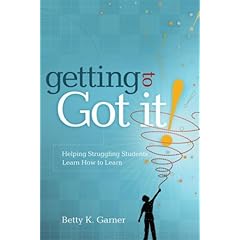
Getting To Got It!


The Administrative Team in my district completes book reviews to make it easier for everyone to receive information for many more titles than we could ever find time to read. With their permission, I will occasionally post some of them for you.

Title: Getting To Got It! Author: Betty K. Garner
Reviewed by: Deb Alden
Note: ASCD Premium and Select Member book, November 2007
Also available as an eBook

Pages: 150 Chapters: 9

Summary:
Cognitive structures are the basic mental processes people use to make sense of information. We use cognitive structures to process information and create meaning by making connections, finding patterns, identifying rules and abstracting principles. Underdeveloped or underused cognitive structures can be a source of learning difficulties and teachers often don't immediately identify this b/c we assume cognitive structures operate automatically. Each individual has to develop his or her own cognitive structures and it is never too late to develop cognitive structures. The premise is that teachers can assist students in development by asking open-ended questions, making sure students understand "why" and "what" they are learning and developing relationships.

Chapters 2-9 go through eight cognitive structures. Each chapter defines the cognitive structure, how to help students develop the cognitive structure and specific suggestions for practice. In addition, throughout these chapters are anecdotal accounts with students in all grades.

Recommendations:
Excellent book for teachers K-12. This book would be great for study groups. Specifically in terms of "Response to Intervention" and the work we are doing with intervention. It really shows what can be done to help students before labeling them with a disability. Not focused on just one subject area. VERY applicable to all subject areas..in this sense it would be a great "all school" read. While reading this book

Other considerations:
A specific chapter could be useful to a teacher of a student with a certain difficulty. These may be used by "student study teams", at referral meetings and also by our school psych. service providers. All ASCD members should have a copy of this book and we will be purchasing several for our central office library.
image from amazon.com


School Leadership that Works

The Administrative Team in my District complete book reviews. With their permission, I would like to post their thoughts here. Many of these works should be read by every educator.

Title: School Leadership that Works: From Research to Results Author: Robert J. Marzano Reviewed by: Thomas Martellone, Principal Greene Central School, Greene, ME

Pages: 193 pages Chapters: Nine Chapters

Summary:

Marzano and associates have cleverly used Meta analysis to truly calculate the impact of leadership on student achievement and school improvement. In Part One of the book (Chapters 1-3), Marzano explains some theories behind leadership and how they analzed the data. Don't be deceived. . . the reading was very navigable and not too filled with jargon. Bottom line, Marzano has shown the relational impact of effective leadership on student achievement. In Part Two (Chapters 4-7), Marzano looks at the 21 responsiblities of a school leader, the types of change that can affect those responsibilities and which approach is best for the different responsibilties. The book closes with how a leadership team may help implement change within a school setting. The epilogue was a challenge due to the technicality of the statistics, although the questionnaires for buiding principals included in that section had great questions about leadership.

Recommendations:

The list of 21 responsibilities was very interesting in regards to all the things that leaders do within their organization. The list was reviewed in table form and correlations were provided with the individual responsibilties. Marzano also goes into more depth after providing specific information about each attribute. Based on the reading, it does look as though leadership plays a key role in the effort to raise student achievement, although individual studies do not necessarily show that. Marzano also skillfully points out the type of change that is necessary for some of the different responsibilities to be realized to their full potential.

Other considerations:

Although this book could be read by anyone in a school setting, it probably would hold the most significance for those people in leadership or administrative roles that want to find ways to increase their impact on student achievement.